1.0 - The Spectrum of Self-Defense
Updated: Aug 26
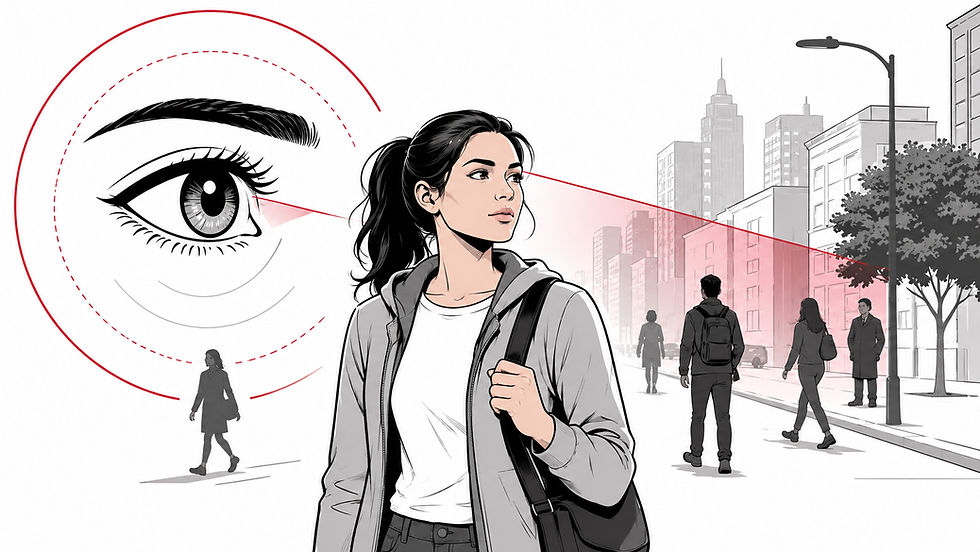
The goal of self-defense and safety is to preserve life, health, autonomy, and safety, not to punish, dominate, or seek revenge. Being safe might require different approaches or strategies depending on the proximity of the perceived threat; Think of this as a spectrum:
Prevention: prevent being targeted.
Evasion: get away from the danger.
Deescalation: make them change their mind.
Fight: your last resort. Flip-the-switch, incapacitate quickly, and escape.
If we want to train effectively and avoid a false sense of safety, we should adjust our own mindset to the realities of modern-day violence.

Common Myths
Many women and girls are taught that using violence is wrong, excessive, or ineffective.
Ethical self-defense rejects this distortion.
A woman is not obligated to remain polite, endure danger or assault simply to keep an attacker comfortable.
Don’t glorify violence
Fantasy narratives centered around domination, humiliation, or revenge may be entertaining in Hollywood, but they’re dangerous in real life.
Violence can be unpredictable, brief, and life altering, even when justified.
Proportionality
Ethical use-of-force should be proportionate to the severity of the threat. In the true sense of the word, this means that a weaker/smaller defender facing a stronger/larger aggressor needs to apply disproportionate force to be effective.
In turn, this means that once the aggressor is no longer posing a threat, to the point where use-of-force is unnecessary, that’s where force should stop.
‘Proportionality’ is not ‘Symmetry’. Allowing yourself to “fight dirty” in a life-threatening situation could save your life.
Your intuition is your superpower
Real-life situations are rarely clear-cut or linear, they could catch you by surprise. Women often hesitate, and wait for absolute proof before acting. Understand what “absolute proof” means in this context.
Proper training empowers you to trust your intuition, trust your judgement, recognize warning signs, and act swiftly, even with partial information.
Dealing with the aftermath

Disengage and escape as soon as possible, try to avoid unnecessary escalation. Once you’re safe:
Do a self-checkup, and seek immediate medical attention if necessary.
Adrenaline can mask the perception of injuries. Once you’re safe, scan your body for signs of injury, wounds, or excessive bleeding (apply a tourniquet if necessary).
Some internal injuries have a delayed effect. If you suspect you might have internal injuries, don’t take the chance. Level A hospitals are better equipped to deal with these types of injuries and can save your life.
Seek legal representation before getting involved with law enforcement.
Know your rights, and seek legal representation, even if you acted in self-defense.
If law enforcement gets involved after the event, do not say anything without an attorney. Until the investigation is concluded, their job is not to protect you, it’s to build a case. Even if you acted in self-defense, you will first be treated as a suspect, and anything you say in the moment could be used as evidence against you.
If a tool was used, it probably has the attacker’s DNA on it. Bag it in a sterile ziplock bag as soon as possible. If counsel allows, this could increase the chances to lead to an arrest dramatically once law enforcement begin searching.
Seek therapy, as close to the event as possible.
Processing the event properly is crucial to prevent mental health issues like PTSD, even if your actions were justified.
The more you delay it, the harder it gets to treat.
In reality, no single method, tool, or technology is guaranteed to prevent assault 100% of the time.
Training yourself to understand, think, act, and adapt lowers the probability of becoming a victim of violence dramatically, while also empowering you to live your life to the fullest!