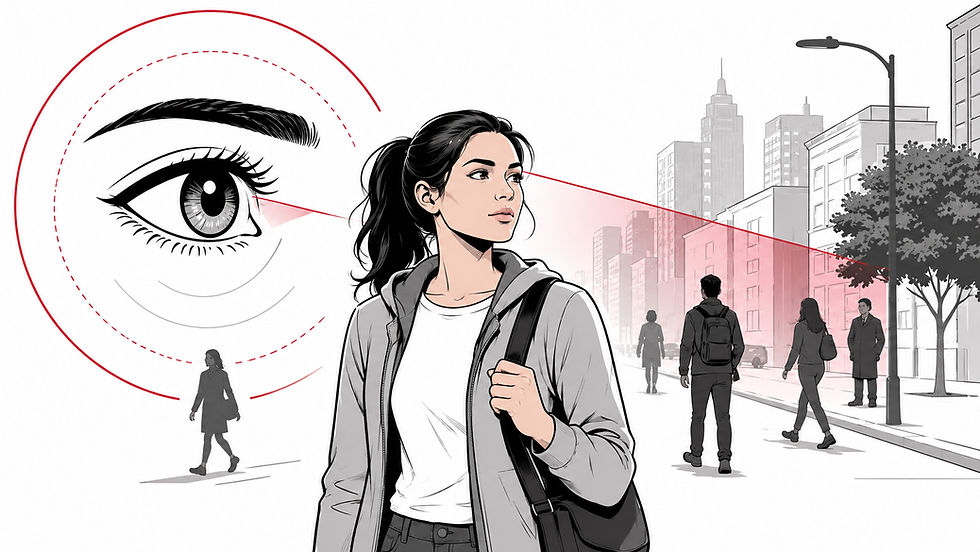
1.3 - Mobility & Escape
Updated: Jul 30
Mobility and escape are often the most underappreciated aspects of self-defense, despite being among the most effective.
Many women intuitively think of self-defense as ‘fighting’. However, self-defense that prioritizes safety often consists of preventing an attacker from gaining access to you in the first place.
The main objective is
Block access → Create distance → Reach safety
An aggressor usually needs:
Proximity - if they can’t reach you, they can’t harm you.
Access - if they can’t get to you, they can’t reach you.
Time - with time comes opportunity, with urgency come mistakes.
Isolation - being witnessed brings consequences.
Mobility directly affects with all four. Unlike fighting, escape does not require overpowering an attacker, or putting yourself at risk. It requires creating enough barriers to remove yourself from the danger entirely.
Remember this: the defender needs one opening. The aggressor needs continued access.
This asymmetry strongly favors escape whenever it remains possible. The deepest principle of escape and mobility is that self-defense is fundamentally a problem of control vs. denial.
An aggressor typically requires a sequence of conditions to succeed:
Detect the target
Approach the target
Access the target
Maintain access
Establish control
Mobility & escape interfere with this sequence at multiple points simultaneously.0
Unlike striking, grappling, or using weapons, mobility is not merely a technique, but a strategic layer that influences the entire encounter from the start.
The Mobility Advantage
Physical confrontation is inherently uncertain.
Even the most highly trained defender cannot guarantee:
Technical success - there’s always a bigger fish.
Physical superiority - predators often count on this asymmetry.
Absence of weapons - anything can be a weapon.
Absence of additional attackers - aggressors can have backup.
Predictable outcomes - no such thing.
Mobility often avoids these uncertainties altogether. If access is denied, many later problems never occur. This is why experienced protection professionals frequently prioritize:
Avoidance
Movement
Positioning
Exit access
…before considering physical engagement.

OPTION PRESERVATION
One of the most important self-defense concepts is: protect options before you need them, including:
Know your exits → planning escapes become difficult under pressure.
Witness access → witnesses carry consequences to offenders.
Access to communication → echoes are your friend in closed spaces.
Environmental flexibility → most barriers are psychological, not physical.
Alternative routes → avoid using the same routes every day.
Many dangerous situations become dangerous because options disappear gradually. For example:
Entering an isolated location.
Allowing oneself to be cornered.
Losing track of exits.
Becoming dependent on another person’s transportation.
Allowing physical proximity to become normalized.
THE CONTROL LADDER
A useful model is the “Control Ladder.” For the defender, each “step” in the ladder increases danger:
Observation → most options…
Attention → plenty of options…
Proximity → fewer options, think quickly.
Access → limited options, act quickly.
Isolation → escape becomes urgent.
Physical contact → escape requires assertive disengagement.
Physical control → neutralize the threat → escape.
Mobility works best at the first levels. The more the aggressor progresses, the more difficult escape becomes. This explains why early movement is disproportionately valuable in preventing dangerous encounters.

MOBILITY BEFORE CERTAINTY
Many women unconsciously tell themselves “I will act once I know the danger is real.”
This mindset is both counterproductive and dangerous; Most preventive mobility actions are inexpensive:
Leaving
Repositioning
Increasing distance
Entering a public space
Returning to a group
These actions carry little cost. Waiting for certainty often carries substantial cost. The objective is not proving danger, but preserving options.
STRATEGIC VS. REACTIVE MOVEMENT
Strategic movement asks:
Where are the exits?
Where can I find witnesses or surveillance?
Where is potential assistance?
Where is my visibility the highest?
Where is access to me the lowest?
Movement without destination awareness can increase vulnerability. Study the different aspects of strategic movement and environments well to move in a way that actually keeps you safe.

MOBILITY IS A RESOURCE
Most people think of mobility as movement.
In self-defense, mobility is better understood as a resource, which includes:
Freedom of movement
Access to exits
Ability to change direction
Ability to reach witnesses
Ability to reach help
Ability to create distance
Reduced mobility ↔ Less options = Higher risk.
Higher mobility ↔ More options = Lower risk.
Escape is a decision
Escape is often portrayed as a physical skill. In reality, escape is primarily a decision-making skill. Most escape opportunities are lost because of:
Hesitation → delayed commitment
Rationalization → social conditioning
Not because movement was physically impossible. The body frequently follows once the decision is made.
THE PSYCHOLOGY OF LEAVING
A major and dangerous obstacle is the belief that leaving requires justification. Many women feel pressured to explain (even to themselves):
Why they are uncomfortable.
Why they are ending interaction.
Why they are leaving.
From a self-defense perspective, mobility does not require permission. The threshold for leaving can simply be...
“I would rather not be here."
No further justification is needed.
Just go.
ESCAPE BEFORE CONTACT
Many people imagine escape beginning after violence starts. While escape is the correct step after physical defense, the safest escape opportunities often occur before physical contact. For example:
Leaving a conversation → creates distance
Entering a populated area → creates witnesses
Changing routes → creates unpredictability
Crossing the street → creates barriers
Returning to a group → creates involvement
Declining an invitation → sets boundaries
These actions may appear insignificant, yet they can completely prevent escalation.
ESCAPE WINDOWS
Dangerous encounters often contain temporary opportunities for escape. Recognizing and acting on them quickly can end an encounter before it even started. For example:
The aggressor gets distracted → they won’t notice you leaving.
The aggressor repositions → new escape routes open.
A door opens → spontaneous escape.
Witnesses appear → unpredictable consequences.
Distance increases briefly → new opportunities open.
Attention shifts elsewhere → break line of sight and disappear.
These moments are opportunity windows. A common mistake is waiting for certainty rather than acting when opportunity appears. Mobility windows tend to shrink rapidly once physical control develops. Recognizing these moments and acting on them (even without complete certainty). Unpredictability always favor the defender.
USE THE ENVIRONMENT
Effective escape relies heavily on the environment. Helpful environmental features include:
Exits → block line of sight and open up new routes.
Crowds → the “Waldo Effect”, the more people are around, the harder you are to follow.
Security personnel → increases offenders’ risk dramatically.
Physical barriers → block access and line of sight.
Light → makes you visible to witnesses.
The environment can function as a force multiplier. Many successful escapes involve environmental advantages rather than just physical superiority.
ESCAPE VS. SAFETY
A critical distinction exists between:
Escape = breaking immediate access
Safety = reaching a secure setting